🧪 Age Reversal Stack Research Guide
Why Combine Tesamorelin and NAD+?
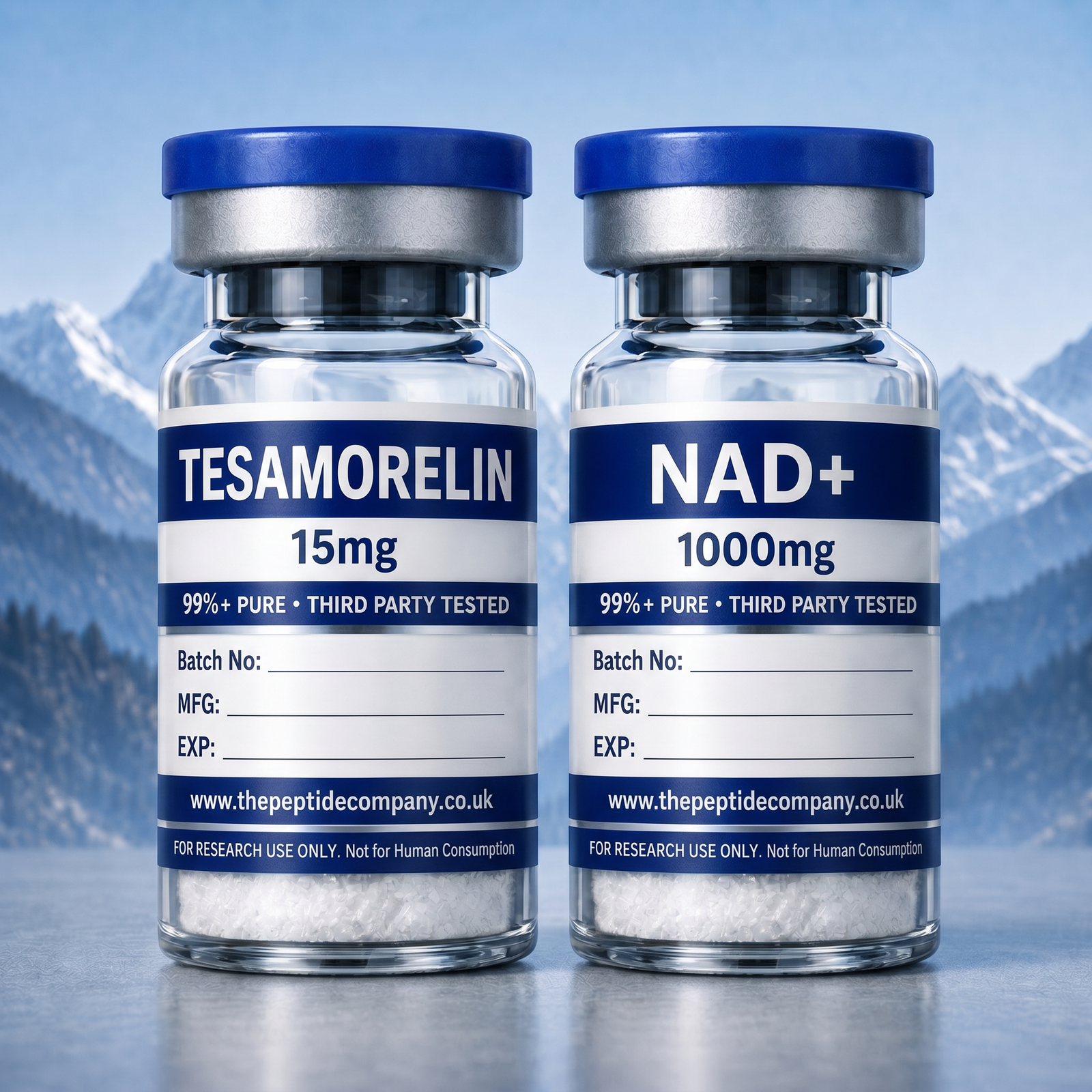
The Age Reversal Stack has become a popular area of investigation because it combines two compounds that operate through different biological pathways. Tesamorelin primarily acts through the growth hormone axis, stimulating the release of endogenous growth hormone and increasing IGF-1 production. Researchers use Tesamorelin to explore body composition, metabolic health, recovery mechanisms and age-related physiological changes.
NAD+ functions as a critical coenzyme involved in hundreds of cellular reactions. It plays an important role in mitochondrial energy production, DNA repair systems, cellular signalling and sirtuin activation.
The Role of Tesamorelin in Research
Tesamorelin is a synthetic analogue of naturally occurring Growth Hormone Releasing Hormone (GHRH). Research has demonstrated that Tesamorelin can increase endogenous growth hormone secretion while elevating circulating IGF-1 levels. Because growth hormone production naturally declines with age, Tesamorelin has become an important tool for studying age-related physiological changes.
- Lean mass preservation
- Body composition
- Growth hormone signalling
- Metabolic function
- Recovery pathways
The Role of NAD+ in Research
NAD+ is found in every living cell and is essential for energy production. Declining NAD+ levels have been observed during ageing, leading to increased scientific interest in NAD+ restoration strategies. Researchers have identified NAD+ as a key component in:
- ATP generation
- Mitochondrial function
- DNA repair
- Sirtuin activation
- Cellular stress responses
Combined Research Applications
Together, these compounds allow researchers to investigate:
- Growth hormone signalling
- Cellular energy production
- Mitochondrial efficiency
- Recovery pathways
- Healthy ageing mechanisms
- Metabolic regulation
❄️ Storage Information
For optimum research purposes, please adhere to the following laboratory storage guidelines:
Tesamorelin 20mg
- Store lyophilised powder at 2-8°C short term
- Long-term storage recommended at -20°C
- Protect from light and moisture
NAD+ 100mg
- Store refrigerated
- Protect from excessive heat
- Avoid repeated freeze-thaw cycles
❓ FAQ Section
What is included in the Age Reversal Stack? One vial of Tesamorelin 20mg and one vial of NAD+ 100mg.
Why are these compounds combined? Researchers often investigate complementary pathways involving growth hormone signalling and cellular energy metabolism.
What is Tesamorelin? Tesamorelin is a synthetic Growth Hormone Releasing Hormone analogue.
What is NAD+? NAD+ is an essential coenzyme involved in cellular energy production and DNA repair.
How should the stack be stored? Storage recommendations are provided with each product and should be followed carefully.
Is this product for human consumption? No. This product is supplied strictly for research use only.
Explore Related Research Compounds
🧬 Advanced Longevity Research: Mechanisms & Synergies
Researchers increasingly recognise that ageing is influenced by multiple biological systems rather than a single pathway. Modern longevity research focuses on understanding how cellular energy production, hormonal regulation and cellular maintenance mechanisms work together to support healthy physiological function throughout life.
One area of significant interest is the relationship between growth hormone signalling and cellular metabolism. Growth hormone and its downstream mediator, insulin-like growth factor-1 (IGF-1), are involved in a variety of biological processes including protein synthesis, tissue maintenance, metabolic regulation and body composition. As individuals age, natural growth hormone production gradually declines, leading researchers to investigate how these pathways influence age-related physiological changes.
The Role of Tesamorelin in Growth Signalling
Tesamorelin has become an important research compound because it stimulates endogenous growth hormone production through Growth Hormone Releasing Hormone pathways. Unlike direct growth hormone administration, Tesamorelin works by encouraging the body’s own regulatory systems, making it valuable for investigating natural growth hormone signalling mechanisms.
NAD+ and Cellular Energy Metabolism
Alongside hormonal pathways, cellular energy production has emerged as another major area of ageing research. Every cell requires a continuous supply of energy to maintain normal function, repair damage and respond to environmental stressors. This energy is generated primarily within mitochondria, where NAD+ plays an essential role.
NAD+ functions as a critical coenzyme in hundreds of metabolic reactions. It participates in ATP production, mitochondrial respiration, DNA repair and cellular signalling. Researchers have observed that NAD+ levels may decrease with age, prompting extensive investigation into the relationship between NAD+ metabolism and healthy ageing.
Another important area of investigation involves sirtuins, a family of proteins that require NAD+ to function correctly. Sirtuins are involved in cellular stress responses, metabolic regulation and DNA maintenance. Because NAD+ availability influences sirtuin activity, researchers frequently explore the interaction between these systems when studying longevity-related pathways.
Complementary Pathways in the Age Reversal Stack
The Age Reversal Stack combines Tesamorelin and NAD+ because they represent two distinct yet complementary areas of ageing research. Tesamorelin focuses on growth hormone and IGF-1 signalling, while NAD+ supports investigation into cellular energy production and mitochondrial function.
Researchers often investigate how these pathways interact to influence cellular resilience, metabolic efficiency and long-term physiological maintenance. By studying multiple systems simultaneously, scientists can gain a broader understanding of the mechanisms that contribute to healthy ageing and cellular function throughout the lifespan.
As longevity science continues to evolve, compounds involved in growth factor signalling and energy metabolism remain among the most actively researched areas within modern peptide and metabolic research.

Reviews
There are no reviews yet.