🧪 Metabolic Stack Research Guide
Understanding Metabolic Health Research
Metabolic health refers to the complex network of biological processes responsible for energy production, nutrient utilisation, glucose regulation and cellular function.
Modern metabolic research increasingly focuses on understanding how cellular energy pathways interact with hormonal signalling systems.
The Metabolic Stack combines two compounds that investigate these pathways from different perspectives.
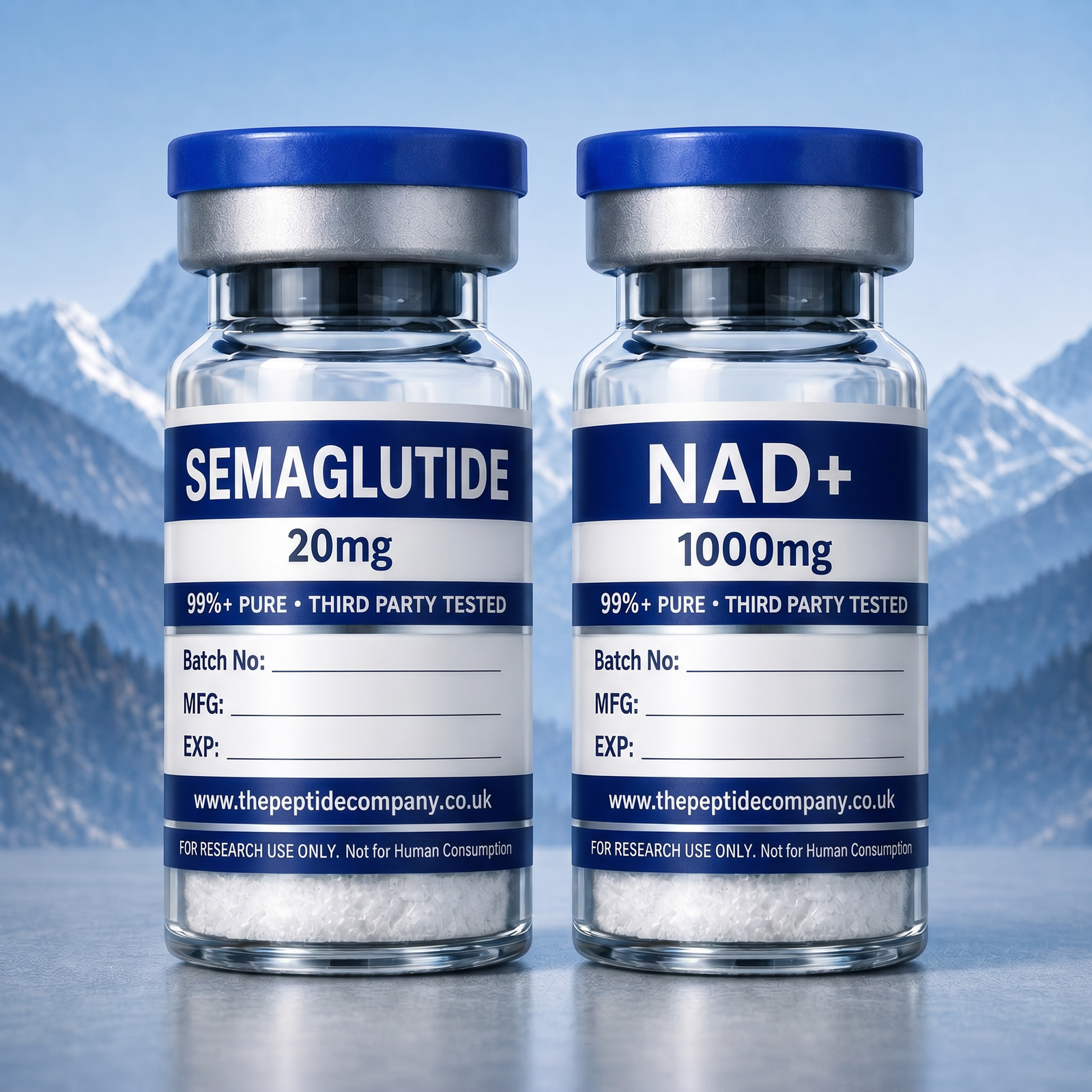
NAD+ focuses primarily on intracellular energy production and mitochondrial function, while Semaglutide is commonly investigated for its role in incretin signalling and metabolic regulation.
Why Combine NAD+ and Semaglutide?
Researchers often investigate complementary biological systems to better understand metabolic adaptation.
NAD+ supports investigation of:
- Cellular energy production
- Mitochondrial efficiency
- DNA repair mechanisms
- Sirtuin activation
- Cellular resilience
Semaglutide supports investigation of:
- Appetite regulation
- Glucose metabolism
- Insulin signalling
- Body composition
- Cardiometabolic health
Together these compounds provide researchers with the opportunity to explore multiple metabolic pathways within a single research framework.
NAD+ and Cellular Energy Production
NAD+ is essential for mitochondrial energy production. Within cells, NAD+ acts as a coenzyme involved in hundreds of metabolic reactions.
Researchers have identified NAD+ as a critical factor in:
- ATP generation
- Oxidative phosphorylation
- Cellular stress responses
- DNA repair pathways
- Healthy ageing research
Interest in NAD+ has grown substantially due to observed age-related declines in NAD+ concentrations across multiple tissues.
Semaglutide and Metabolic Regulation
Semaglutide is one of the most extensively researched GLP-1 receptor agonists available. GLP-1 signalling influences:
- Appetite regulation
- Satiety responses
- Glucose homeostasis
- Insulin secretion
- Metabolic adaptation
Large-scale clinical trials have established Semaglutide as one of the most important compounds in modern obesity and metabolic research.
Potential Research Areas
Researchers commonly investigate:
- Cellular Energy Pathways: Understanding how cells generate and utilise energy.
- Mitochondrial Function: Examining metabolic efficiency and cellular performance.
- Glucose Regulation: Investigating mechanisms involved in glucose handling.
- Metabolic Adaptation: Understanding how biological systems respond to changes in nutrient availability and energy demand.
- Healthy Ageing Research: Exploring pathways associated with longevity and cellular resilience.
Storage Information
NAD+ 100mg
- Store refrigerated
- Protect from heat and moisture
- Long-term storage recommended at -20°C
Semaglutide 20mg
- Store refrigerated
- Avoid repeated freeze-thaw cycles
- Protect from direct light
Research Use Only
This product is supplied strictly for laboratory and scientific research purposes.
- Not for human consumption
- Not intended to diagnose, treat, cure or prevent disease
- Not approved for therapeutic use
- For qualified researchers only
❓ Frequently Asked Questions
What is included in the Metabolic Stack?One vial of NAD+ 100mg and one vial of Semaglutide 20mg.
Why are these compounds combined?Researchers investigate complementary pathways involving cellular energy production and metabolic regulation.
What is NAD+?NAD+ is an essential coenzyme involved in energy metabolism and cellular repair mechanisms.
What is Semaglutide?Semaglutide is a GLP-1 receptor agonist commonly investigated in metabolic and obesity research.
What research areas are commonly explored?Metabolic health, mitochondrial function, glucose metabolism, energy production and healthy ageing pathways.
How should these compounds be stored?Researchers should follow the storage recommendations supplied with the products.
Are these products intended for human use?No. These products are supplied strictly for research purposes.
Can NAD+ and Semaglutide be investigated together?Researchers may explore complementary metabolic pathways using both compounds within the same study design.
What makes this stack different from the GLP Transformation Stack?The Metabolic Stack combines a cellular energy compound (NAD+) with a GLP-1 research compound (Semaglutide), whereas the GLP Transformation Stack focuses entirely on incretin-based metabolic pathways.
What makes this stack different from the Age Reversal Stack?The Age Reversal Stack combines NAD+ with Tesamorelin and is generally positioned around healthy ageing and growth hormone research, whereas the Metabolic Stack focuses on energy metabolism and glucose regulation.
🧬 Understanding Energy Metabolism and Cellular Function
Energy metabolism is one of the most fundamental biological processes required for life. Every cell within the body relies upon a continuous supply of energy to support growth, maintenance, repair and normal physiological function.
Researchers studying metabolic health frequently focus on understanding how energy is generated, stored and utilised throughout the body. This includes investigating both cellular energy systems and the hormonal signals that regulate nutrient utilisation.
The Central Role of NAD+
NAD+ occupies a central role within these processes. As an essential coenzyme, NAD+ participates in hundreds of biochemical reactions involved in cellular metabolism. It is required for efficient mitochondrial function and serves as a key component of ATP production pathways.
ATP acts as the primary energy currency of the cell. Without adequate ATP production, cells cannot effectively perform the processes necessary for maintenance and survival. Because NAD+ contributes directly to ATP generation, researchers consider it one of the most important molecules involved in cellular energy metabolism.
In addition to its role in energy production, NAD+ participates in DNA repair mechanisms, cellular signalling pathways and mitochondrial maintenance. These functions have contributed to growing scientific interest in NAD+ within both metabolic and longevity research.
Systemic Regulation via Semaglutide
Semaglutide contributes a complementary area of investigation. Rather than acting directly within cellular energy pathways, Semaglutide primarily influences metabolic regulation through GLP-1 receptor activation. Researchers study how these pathways affect appetite signalling, nutrient utilisation and glucose homeostasis.
The combination of NAD+ and Semaglutide allows researchers to investigate metabolism from two distinct perspectives. NAD+ focuses on intracellular energy production, while Semaglutide influences systemic metabolic signalling.
Interconnected Metabolic Pathways
Modern research increasingly recognises that metabolic health cannot be understood through a single pathway alone. Instead, cellular energy production, hormonal signalling and nutrient sensing systems operate together to maintain metabolic balance.
Researchers are therefore interested in understanding how mitochondrial function interacts with endocrine signalling pathways. These interactions may influence glucose metabolism, energy expenditure and physiological adaptation to environmental conditions.
Another important area of investigation involves metabolic flexibility. This refers to the body’s ability to adapt fuel utilisation based on changing energy demands. Scientists continue to explore the biological mechanisms responsible for maintaining this adaptability and how cellular energy systems contribute to overall metabolic function.
Advanced Research Opportunities
The Metabolic Stack provides a valuable research platform for exploring these interconnected pathways. By combining NAD+ and Semaglutide, researchers can investigate both cellular and systemic aspects of metabolism within a single framework.
As understanding of metabolic biology continues to advance, compounds that influence energy production and metabolic signalling remain among the most scientifically relevant areas of investigation.



Daniel Jacob’s –
This Metabolic Stack NAD+ & Semaglutide is a game-changer!
The combination of Semaglutide for powerful appetite control and weight loss with NAD+ for boosted cellular energy and metabolism works incredibly well.
I’ve experienced steady fat loss, sustained energy, fewer cravings, and no major fatigue.
The NAD+ and Semaglutide stack from the peptide company, delivers clean, high-quality peptides with fast results.
Highly recommend this peptide stack for anyone serious about weight loss and metabolic health.
Would buy again!