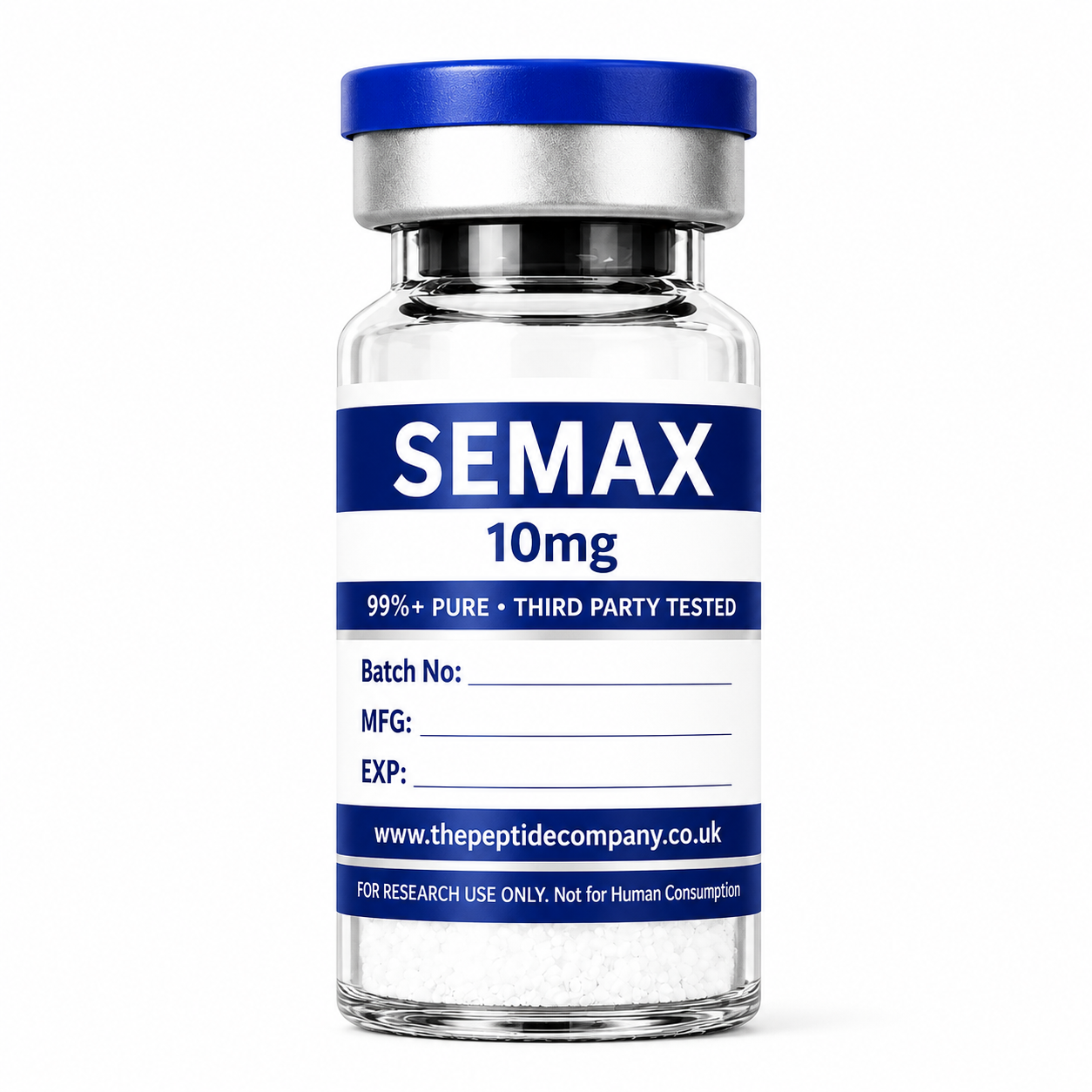
🧪 Semax 10mg Research Guide
What is Semax?
Semax is a synthetic heptapeptide derived from a fragment of adrenocorticotropic hormone (ACTH) and has become one of the most extensively researched peptides within the fields of neuroscience, neuroprotection, and cognitive function. Originally developed through peptide research programs investigating neurological signalling pathways, Semax continues to attract significant scientific interest due to its unique interaction with neurotrophic factors and neurotransmitter systems.
Unlike many research peptides that primarily target hormone receptors or metabolic pathways, Semax is investigated for its potential influence on neuronal communication, neuroplasticity, and mechanisms involved in cognitive performance. Researchers have explored Semax in studies examining memory formation, learning processes, behavioural adaptation, neuroprotection, and the regulation of brain-derived neurotrophic factor (BDNF).
Its unique structure allows researchers to investigate how peptide signalling may influence neurological pathways associated with neuronal growth, resilience, and adaptation. As a result, Semax remains a valuable tool in experimental neuroscience and neurochemical research.
Pharmacokinetic Research Characteristics
One area of scientific interest surrounding Semax involves its pharmacokinetic profile and stability within experimental environments. Researchers have investigated the peptide’s resistance to enzymatic degradation compared to naturally occurring ACTH fragments, helping to explain its continued use in neurological research.
The addition of the Pro-Gly-Pro sequence during development was designed to improve stability and extend biological activity. This modification has allowed researchers to study Semax in experimental models requiring prolonged peptide exposure while maintaining structural integrity.
Gene Expression Research
Scientific investigations have demonstrated that Semax may influence the expression of numerous genes associated with neuronal function and cellular adaptation. Researchers have used advanced molecular techniques to examine changes in gene activity following peptide exposure within experimental models.
Particular attention has been focused on genes involved in neurotrophic signalling, neuronal survival pathways, inflammatory regulation, and cellular stress responses. These findings have contributed to a growing body of evidence suggesting that Semax may influence neurological function through mechanisms extending beyond traditional neurotransmitter modulation.
Research Applications
Semax continues to be utilised across a wide range of scientific disciplines, including:
- Neuroscience research
- Cognitive function studies
- Memory and learning investigations
- Neuroplasticity research
- Neuroprotection studies
- Neurotransmitter regulation analysis
- Behavioural science research
- Peptide signalling investigations
- Experimental neurological models
- BDNF and NGF expression studies
❄️ Storage Information
For optimal stability and research integrity, Semax should be stored according to appropriate laboratory handling guidelines.
Semax 10mg
- Store lyophilised product at -20°C
- Protect from excessive heat and moisture
- Reconstitute using bacteriostatic water or another suitable laboratory solvent
- Use appropriate sterile laboratory techniques
- Following reconstitution, store prepared solutions between 2°C and 8°C
- Avoid repeated freeze-thaw cycles after reconstitution
Proper handling and storage help preserve peptide integrity and support consistent research outcomes.
❓ FAQ Section
What is Semax?
Semax is a synthetic heptapeptide derived from a fragment of ACTH and widely researched in neuroscience, cognitive function, neuroplasticity, and neuroprotection studies.
What is Semax commonly researched for?
Researchers study Semax in relation to cognitive performance models, memory, learning, neuroplasticity, neurotransmitter regulation, and neurotrophic factor expression.
What neurotrophic factors are associated with Semax research?
Semax has been investigated for its potential relationship with brain-derived neurotrophic factor (BDNF) and nerve growth factor (NGF) signalling pathways.
How should Semax 10mg be stored?
Lyophilised Semax should be stored at -20°C and protected from excessive heat, moisture, and repeated freeze-thaw cycles.
What form is Semax supplied in?
Semax 10mg is supplied as a lyophilised research peptide in sterile vials.
Is this product for human consumption?
No. Semax 10mg is supplied strictly for laboratory and scientific research use only.
Explore Related Research Compounds
🧬 Advanced Neuroscience Research: Mechanisms & Research Interest
Modern neuroscience research increasingly focuses on understanding how peptide signalling may influence neuronal communication, neuroplasticity, gene expression, and cellular adaptation. Semax remains a significant research compound because it is studied across multiple neurological pathways rather than a single biological target.
Neuroplasticity Research
Neuroplasticity refers to the brain’s ability to reorganise and adapt through the formation of new neural connections. This process is fundamental to learning, memory, behavioural adaptation, and cognitive development.
Semax has been extensively studied in relation to neuroplasticity due to its reported effects on neurotrophic factor expression and neuronal signalling pathways. Research suggests the peptide may contribute to mechanisms associated with synaptic adaptation and neuronal communication, making it particularly relevant in studies investigating how the brain responds to environmental changes and cognitive challenges.
Cognitive Function Research
One of the most frequently investigated areas involving Semax is cognitive performance research. Scientists have explored the peptide in experimental models focused on memory, learning, information processing, and behavioural adaptation. Studies continue to investigate potential relationships between Semax and mechanisms associated with memory consolidation, attention regulation, and learning efficiency.
Neuroprotection Research
Neuroprotection represents another major area of scientific interest involving Semax. Researchers have investigated the peptide in experimental models designed to examine neuronal resilience and survival under various conditions. Scientific studies suggest Semax may influence pathways associated with oxidative stress responses, inflammatory signalling, and cellular adaptation.
Neurotrophic Factor Research
One of the most extensively studied aspects of Semax is its relationship with neurotrophic factors. Neurotrophic factors are specialised proteins that play essential roles in the development, maintenance, and survival of neurons throughout the nervous system.
Among these, brain-derived neurotrophic factor (BDNF) and nerve growth factor (NGF) have received significant attention in Semax-related research. Researchers continue to investigate how modulation of neurotrophic signalling may affect neuronal adaptation under various experimental conditions.
Neurotransmitter System Research
In addition to its effects on neurotrophic factors, Semax has been studied for its interaction with several major neurotransmitter systems. Research suggests Semax may influence dopaminergic pathways, which are involved in motivation, reward processing, and behavioural adaptation.
Investigations have also examined its effects on serotonergic signalling, which plays an important role in cognition and emotional processing. Furthermore, studies have explored potential interactions with cholinergic pathways that contribute to memory formation, attention, and learning.
Why Researchers Study Semax
Semax has established itself as one of the most widely investigated neuroactive peptides due to its broad range of potential research applications. Unlike many peptides that focus primarily on endocrine or metabolic pathways, Semax offers researchers the opportunity to explore cognitive, neurological, and neuroprotective mechanisms simultaneously.
As neuroscience research continues to expand, Semax remains an important compound for investigating biological mechanisms involved in cognitive function, neuronal adaptation, neuroplasticity, and neurochemical signalling.
✅ Quality & Research Standards
Semax 10mg is supplied as a high-purity lyophilised peptide suitable for laboratory and scientific research applications.
Each vial undergoes rigorous quality control procedures designed to verify identity, purity, and consistency. The lyophilised format provides enhanced stability for storage and transportation while allowing researchers flexibility during preparation for experimental use.
Research-grade manufacturing standards help ensure reproducibility across studies and maintain product integrity throughout the research process.
⚠️ Research Use Only
Semax 10mg is supplied exclusively for laboratory and scientific research purposes.
This product is not intended for human consumption, medical use, therapeutic applications, diagnosis, treatment, or prevention of disease. Any use outside of approved research environments is strictly prohibited.
Reviews
There are no reviews yet.