The Peptide Company – Navbar

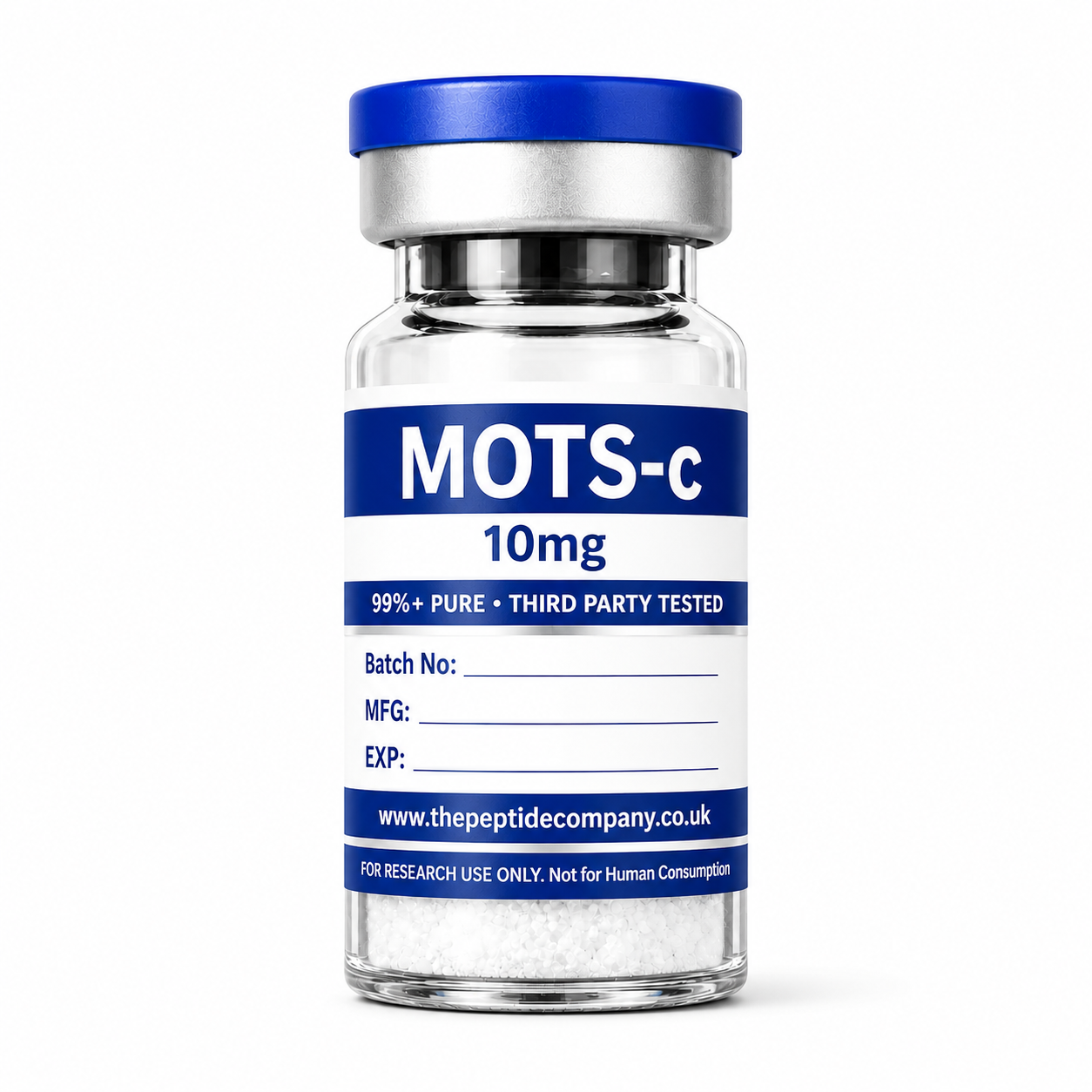
MOTS-c

£27.00

ProductAmountDiscount
Buy 2 - Save £102 £5.00 flat
Buy 3 - Save £303 - 4 £10.00 flat
Buy 5 - Save £755 + £15.00 flat
Category:

“`html

Strictly for Research Purposes Only
This product: MOTS-c 10mg is not intended for human consumption, diagnostic, or therapeutic use. It has not been evaluated or approved by the FDA. Misuse is strictly prohibited and may result in legal consequences.

MOTS-c Purity
≥98%

Class
Mitochondrial-Derived Peptide

Form
Lyophilized Powder

Storage
-20°C

🔬 Technical Specifications
MOTS-c 10mg
Molecular Formula
C101H152N28O22S2

Molecular Weight
~2174.62 g/mol

Peptide Sequence
MRWQEMGYIFYPRKLR

Amount Per Vial
10mg in sterile 2ml vial

Form
Lyophilized powder

Stability
Reconstitute before research use

Shipping & Handling
✓ Shipped in temperature-controlled packaging
✓ Same-day dispatch for orders before 2PM
✓ Discreet, plain packaging

🧪 Scientific Background
MOTS-c: MOTS-c is a mitochondrial-derived peptide encoded within the mitochondrial 12S ribosomal RNA region. Unlike most signalling peptides, which originate from nuclear DNA, MOTS-c is encoded directly within mitochondrial DNA. This unique origin has made it an important research compound in studies exploring mitochondrial biology, cellular energy regulation, and metabolic signalling.
MOTS-c belongs to a family of mitochondrial-derived peptides that are studied for their role in cellular communication and adaptive stress responses. Researchers have investigated MOTS-c for its potential involvement in mitochondrial-to-nuclear communication, metabolic homeostasis, glucose regulation, exercise adaptation, and cellular resilience.
Its discovery has helped expand scientific understanding of mitochondria beyond their traditional role as cellular energy producers. Rather than functioning only as organelles responsible for ATP production, mitochondria are now understood to contribute to signalling networks that influence gene expression, cellular adaptation, and stress-response pathways.
⚙️ Mechanism of Action
Research suggests MOTS-c may influence several pathways associated with cellular energy regulation and metabolic adaptation. One of the most widely studied pathways is AMP-activated protein kinase, commonly referred to as AMPK. AMPK acts as a cellular energy sensor and helps regulate how cells respond to changes in nutrient availability and energy demand.
Studies have also investigated MOTS-c for its ability to translocate from mitochondria into the nucleus under conditions of metabolic stress. Once inside the nucleus, MOTS-c may influence the expression of genes involved in stress adaptation, antioxidant responses, and metabolic regulation.
This mitochondrial-to-nuclear signalling activity is one of the most distinctive features of MOTS-c research. It allows scientists to explore how mitochondria communicate with nuclear DNA and how this communication may contribute to cellular resilience, energy balance, and adaptive responses under experimental conditions.

🧫 Recommended Handling
  • Reconstitution: Reconstitute with bacteriostatic water or another suitable laboratory solvent before research use.
  • Storage: Store lyophilised material at -20°C. Following reconstitution, refrigeration between 2°C and 8°C is recommended.
  • For Research Use Only: Not intended for human consumption, diagnosis, treatment, or therapeutic applications.
Research Applications
  • Mitochondrial function studies
  • Cellular energy regulation research
  • Metabolic adaptation investigations
  • AMPK signalling pathway research
  • Exercise physiology studies
  • Healthy ageing research
  • Mitochondrial-to-nuclear communication studies
  • Gene expression investigations
  • Cellular stress-response models
  • Peptide signalling pathway analysis
  • Metabolic flexibility research
  • Glucose metabolism research

Scientific Studies: Efficacy & Safety

  • 1. MOTS-c Supports Metabolic Homeostasis in Experimental Models
    Study: Lee et al. — Cell Metabolism, 2015

    • Researchers identified MOTS-c as a mitochondrial-derived peptide involved in metabolic regulation.
    • MOTS-c was shown to influence glucose metabolism and metabolic flexibility in experimental models.
    • Findings suggested a role for MOTS-c in adaptive responses to metabolic stress.
    • The study helped establish MOTS-c as a significant peptide in mitochondrial and metabolic research.
    • PubMed: https://pubmed.ncbi.nlm.nih.gov/25620558/
  • 2. MOTS-c Regulates Nuclear Gene Expression During Cellular Stress
    Study: Kim et al. — Nature Communications, 2018

    • Researchers demonstrated that MOTS-c can translocate from mitochondria into the nucleus during cellular stress.
    • Nuclear localisation was associated with regulation of genes involved in cellular adaptation.
    • Findings provided evidence of direct mitochondrial-to-nuclear communication.
    • The study expanded understanding of mitochondrial-derived peptides as signalling molecules.
    • PubMed: https://pubmed.ncbi.nlm.nih.gov/30420685/
MOTS-c 10mg is supplied as a lyophilised research peptide intended exclusively for laboratory and scientific research applications. Not for human consumption.

Explore Related Research Compounds


“`

Additional information

“`html

🧪 MOTS-c 10mg Research Guide
Research Applications of MOTS-c
MOTS-c is a mitochondrial-derived peptide that has generated significant scientific interest due to its unique origin and potential role in cellular energy regulation. Unlike most peptides, which are encoded by nuclear DNA, MOTS-c is encoded within mitochondrial DNA, making it an important subject in studies involving mitochondrial signalling and cellular adaptation.
Researchers continue investigating MOTS-c across a broad range of fields including metabolism, mitochondrial biology, exercise physiology, cellular resilience, and healthy ageing.
Mitochondrial Function Research
One of the primary areas of investigation focuses on mitochondrial communication and energy production. Researchers study MOTS-c to better understand how mitochondria influence cellular adaptation and metabolic homeostasis.
Metabolic Regulation Research
Scientific investigations frequently explore how MOTS-c may interact with pathways involved in nutrient sensing, glucose metabolism, and cellular energy balance. These studies help researchers examine mechanisms associated with metabolic flexibility and adaptive responses to changing energy demands.
Exercise Physiology Research
Researchers continue investigating the relationship between MOTS-c and exercise-induced cellular adaptation. Scientific literature suggests mitochondrial-derived peptides may participate in biological processes associated with physical activity and energy utilisation.
Cellular Stress Response Studies
MOTS-c is often studied in experimental models examining how cells respond to environmental and metabolic stressors. Researchers investigate how mitochondrial signalling molecules may contribute to cellular resilience and adaptive stress-response mechanisms.
Healthy Ageing Research
Age-related changes in mitochondrial function remain a major area of scientific interest. Researchers continue exploring whether mitochondrial-derived peptides such as MOTS-c may play a role in maintaining normal cellular adaptation and communication throughout the ageing process.
Areas of Scientific Interest
  • Mitochondrial biology
  • Metabolic regulation
  • Exercise physiology
  • Cellular resilience
  • Healthy ageing research
  • Energy metabolism studies
  • Gene expression investigations
  • Cellular stress-response studies
⚡ Cellular Energy Research
One of the primary reasons researchers continue to investigate MOTS-c is its association with cellular energy regulation. Every cell requires a constant supply of energy to maintain normal biological functions, and mitochondria play a central role in this process.
Scientific investigations have explored how MOTS-c may participate in signalling pathways involved in energy sensing and metabolic adaptation. Researchers are particularly interested in understanding how mitochondrial-derived peptides help cells respond to fluctuations in nutrient availability, physical activity, and environmental stressors.
Unlike many signalling molecules that originate from nuclear DNA, MOTS-c provides a unique opportunity to study communication pathways originating directly from mitochondria. This has expanded scientific understanding of how energy-producing organelles may actively influence broader cellular behaviour.
Current research continues to investigate the relationship between MOTS-c and mechanisms involved in maintaining metabolic homeostasis, supporting cellular adaptation, and coordinating responses to changing energy demands.
🔬 Understanding How MOTS-c Works
Mitochondrial Signalling Research
MOTS-c belongs to a growing class of compounds known as mitochondrial-derived peptides (MDPs). Researchers investigate these compounds because they appear to function as signalling molecules that allow mitochondria to communicate with other parts of the cell.
Unlike traditional signalling peptides that originate from nuclear DNA, MOTS-c is encoded directly within mitochondrial DNA, making it unique among research peptides currently available.
Nuclear Translocation Research
One of the most distinctive characteristics of MOTS-c is its ability to relocate from the mitochondria into the nucleus during periods of metabolic stress.
Researchers study this process because it may provide insight into how mitochondria influence gene expression and cellular adaptation. Scientific investigations suggest this mechanism may play a role in coordinating cellular responses to environmental and metabolic challenges.
AMPK Pathway Research
MOTS-c is frequently studied in relation to AMP-activated protein kinase (AMPK), a major regulator of cellular energy balance. Researchers investigate this relationship because AMPK is involved in nutrient sensing, metabolic adaptation, mitochondrial signalling, and stress-response pathways.
  • Cellular energy regulation
  • Nutrient sensing
  • Metabolic adaptation
  • Mitochondrial signalling
  • Stress-response pathways
Cellular Adaptation Research
Researchers continue investigating how MOTS-c may influence cellular adaptation mechanisms under varying physiological conditions.
  • Stress-response signalling
  • Energy regulation
  • Metabolic flexibility
  • Mitochondrial communication
  • Gene expression pathways
📊 Why Researchers Study MOTS-c
Mitochondrial Origin
Unlike most peptides currently studied, MOTS-c originates directly from mitochondrial DNA. This provides researchers with a valuable model for understanding mitochondrial signalling and communication pathways.
Gene Expression Research
Scientific investigations have demonstrated that MOTS-c may influence nuclear gene expression under specific experimental conditions. Researchers continue exploring these interactions to better understand cellular adaptation mechanisms.
Broad Research Applications
MOTS-c is relevant across numerous fields including mitochondrial biology, metabolic regulation, exercise physiology, cellular resilience, healthy ageing research, and energy metabolism studies.
Expanding Scientific Literature
Since its discovery, the volume of published MOTS-c research has continued to grow, making it one of the most actively investigated mitochondrial-derived peptides available for laboratory use.
⚖️ MOTS-c vs Other Mitochondrial Peptides
MOTS-c vs Humanin
Both peptides originate from mitochondrial DNA, however researchers investigate different signalling pathways and biological functions.
MOTS-c vs SHLP Peptides
SHLP peptides represent another family of mitochondrial-derived peptides. Researchers continue studying how their biological activities compare with those observed in MOTS-c models.
MOTS-c vs NAD+
Although both are commonly discussed within mitochondrial research, NAD+ functions as a coenzyme involved in cellular metabolism, whereas MOTS-c is a signalling peptide encoded by mitochondrial DNA.
MOTS-c vs SS-31
SS-31 is frequently studied for mitochondrial targeting and membrane interactions, while MOTS-c research primarily focuses on signalling pathways, metabolic adaptation, and mitochondrial communication.
❄️ Storage and Handling Information
Proper storage is important for maintaining peptide quality and stability.
Lyophilised Powder
Prior to reconstitution, MOTS-c should generally be stored frozen at approximately -20°C.
Reconstituted Material
Following reconstitution, researchers typically store solutions under refrigerated conditions and utilise them within appropriate laboratory timeframes.
Environmental Protection
  • Protect from excessive heat
  • Protect from direct sunlight
  • Avoid moisture exposure
  • Reduce contamination risks
  • Minimise repeated freeze-thaw cycles
Laboratory Best Practices
  • Use sterile handling procedures
  • Wear appropriate PPE
  • Maintain accurate laboratory records
  • Follow established research protocols
  • Store materials appropriately between uses
❓ FAQ Section
What is MOTS-c?
MOTS-c is a mitochondrial-derived peptide encoded within mitochondrial DNA and studied for its potential role in cellular energy regulation and mitochondrial signalling.
What type of peptide is MOTS-c?
It is classified as a mitochondrial-derived peptide, also known as an MDP.
Why do researchers study MOTS-c?
Scientists investigate MOTS-c because of its involvement in mitochondrial communication, metabolic adaptation, cellular signalling, and energy regulation pathways.
What form is supplied?
MOTS-c is supplied as a lyophilised powder for laboratory research use.
Why is lyophilised powder used?
Freeze-drying improves stability during storage and transportation and helps preserve peptide integrity.
How should MOTS-c be stored?
Researchers generally store lyophilised MOTS-c at -20°C until required for laboratory use.
What research fields commonly involve MOTS-c?
Areas of investigation include mitochondrial biology, metabolic research, exercise physiology, cellular stress-response studies, healthy ageing research, and gene expression investigations.
Why is purity important?
High purity helps improve consistency, reproducibility, and reliability across scientific studies.
Can MOTS-c be studied alongside other compounds?
Researchers frequently investigate MOTS-c alongside compounds such as Humanin, SHLP peptides, NAD+, SS-31, and AICAR depending on experimental objectives.
Is this product intended for human consumption?
No. This product is supplied strictly for laboratory and scientific research purposes only.
🧬 Scientific Background of Mitochondrial-Derived Peptides
Understanding Mitochondrial Communication
Mitochondria have traditionally been recognised as the primary energy-producing organelles within cells. However, modern research has revealed that mitochondria also participate in complex signalling networks that influence metabolism, cellular adaptation, and stress responses.
Mitochondrial-derived peptides such as MOTS-c have expanded scientific understanding of how mitochondria communicate with the nucleus and other cellular systems.
  • Mitochondrial signalling
  • Cellular adaptation
  • Metabolic regulation
  • Gene expression pathways
  • Stress-response mechanisms
  • Energy homeostasis
  • Age-related biological changes
🧪 Future Directions in MOTS-c Research
The discovery of MOTS-c has opened new areas of investigation within mitochondrial biology and peptide science. Researchers continue exploring how mitochondrial-derived peptides contribute to communication networks that influence cellular adaptation, resilience, and metabolic regulation.
One area of growing interest involves understanding how MOTS-c interacts with other signalling molecules involved in energy metabolism and stress-response pathways. Scientists are working to better understand the complex relationships between mitochondrial communication, gene expression, and cellular function.
Researchers are also investigating how MOTS-c behaves under different experimental conditions, including models involving metabolic stress, exercise adaptation, mitochondrial dysfunction, and age-related biological changes.
As scientific knowledge continues to expand, MOTS-c remains at the forefront of mitochondrial peptide research due to its unique origin, extensive research applications, and growing body of published literature.
Explore Related Research Compounds
⚠️ Research Use Only
MOTS-c 10mg is supplied exclusively for laboratory and scientific research purposes.
This product is not intended for human consumption, medical use, therapeutic applications, diagnosis, treatment, or prevention of disease. Any use outside of approved research environments is strictly prohibited.


“`

Reviews

There are no reviews yet.

Be the first to review “MOTS-c”

Your email address will not be published. Required fields are marked *

Shopping Cart
Scroll to Top
Checkout Exclusive

Add Gummies to Your Order & Save 50%

Before you complete checkout, add our Himalayan Shilajit Gummies to your order and get an instant 50% discount.

🍬

Himalayan Shilajit Gummies – 3000mg

Limited checkout-only offer. Discount applies only to this gummies product.

Add Gummies & Save 50%